
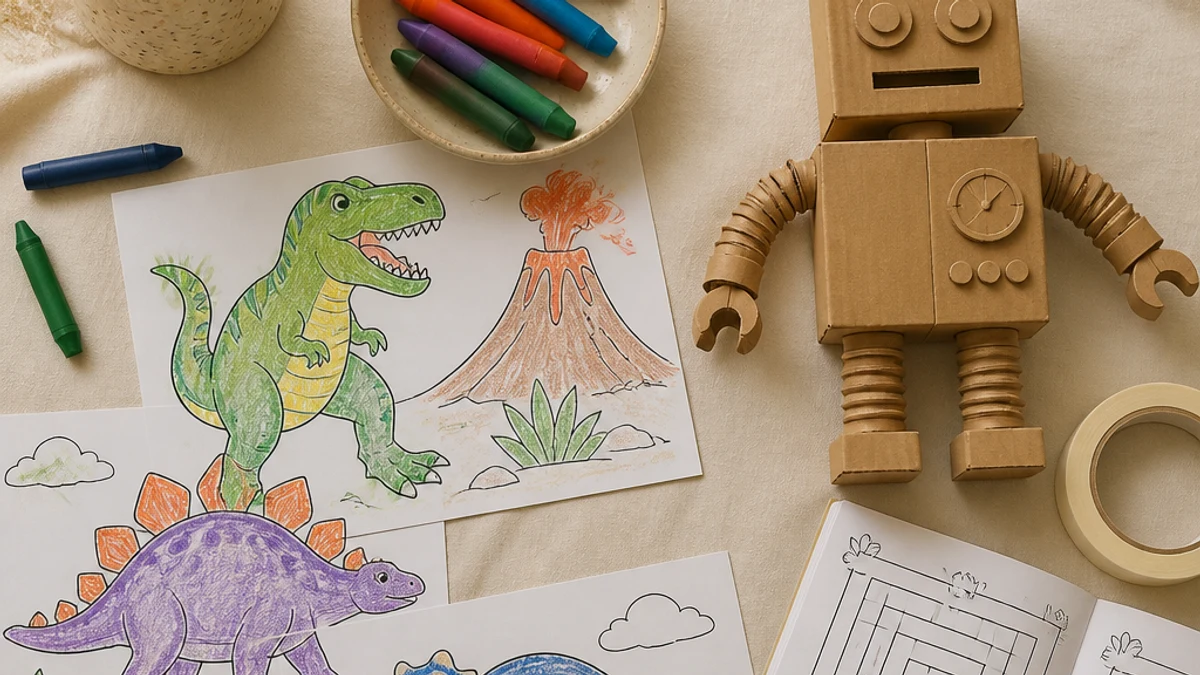
It's Saturday morning. Breakfast is done, the toys are already boring, and someone wants to know what happens next.
You don't need to plan out the whole day. Two or three things is usually enough.
Here are five ideas that use stuff you probably already have at home. Each one says how long it takes to set up, how messy it gets, and roughly how long it keeps kids busy.
1. Build something out of the recycling
Prep: 5 minutes. Mess: medium, mostly paper scraps. Keeps them busy: 30 to 90 minutes.
Save a couple of delivery boxes instead of flattening them. Put them on the floor along with paper tubes, masking tape, string, safety scissors and a few bottle caps.
Give them a challenge rather than instructions. "Make a robot" usually gets a blank look. "Can you build something that carries three toy cars?" gives them an actual problem. They'll try it, it won't work, they'll try again. You can sit nearby with your coffee instead of running the whole thing.
Some ideas:
- Ages 3 to 5: a crown, a bus, a little bed for a toy
- Ages 6 to 9: a puppet theatre, a marble run, a cardboard town
- Ages 10 and up: a maze, a grabber arm, a catapult
Use masking tape rather than glue. It holds well enough and it comes off furniture.
Try not to fix their work. If a wall is crooked, leave it crooked. They're always prouder of the one they made themselves.
Take a photo before it goes in the recycling. It makes throwing it out much easier later.
2. Coloring, with pages they actually like
Prep: 10 minutes, ideally the night before. Mess: almost none. Keeps them busy: 20 to 60 minutes, longer if you join in.
Coloring is good for after lunch, when everyone needs a quiet half hour. You included.
The main thing is picking the right pages. A kid who loves sharks won't sit down for a teddy bear. An older kid won't bother with something drawn for toddlers. When coloring only lasts four minutes, it's usually the wrong page rather than a bored kid.
Pick something they're into right now, and match the detail to their age:
- Ages 3 to 5: thick lines and big simple shapes. Animals, cars, fish
- Ages 6 to 9: full scenes. Dinosaurs, space, castles, jungle animals
- Ages 10 and up: detailed patterns, mandalas, anime, cozy rooms
Older kids often say they're too old for coloring. Usually they've just never been given the right page. Hand an eleven year old a detailed mandala and they might sit there for an hour.
If you can't find pages that fit, you can make your own set with the InkChamps coloring book maker. Type in something like "friendly dinosaurs having a picnic" and pick an age level. It helps when two kids want completely different things and you'd rather not sort it out.
Print a page for yourself too. Kids stay at the table much longer when an adult is coloring as well, and you end up talking while you do it. Stick the finished pages on the fridge or along a wall.
3. Make a small puzzle booklet
Prep: 15 minutes the night before. Mess: none. Keeps them busy: they come back to it all weekend.
Some kids would rather solve something than color it. Print a few puzzles and staple them into a little booklet.
The staple sounds like a small thing but it matters. A booklet feels like something made for them. Loose sheets feel like homework.
What to put in:
- A word search using words from something they like
- Two mazes, with the second one harder
- A spot the difference page
- A small four by four sudoku for an older kid
- A tracing page for a preschooler
Keep one theme all the way through. If they're into space, do an astronaut maze, a planet word search and a rocket spot the difference. You can put the pages together yourself, or make a themed set with the InkChamps activity book creator, which prints an answer key too so you're not solving the maze yourself.
Don't expect them to finish it in one sitting. Leave it on the coffee table. Coming back to it three or four times across the weekend is better than finishing it before lunch.
4. Hide and seek with one rule changed
Prep: none. Mess: none, but it gets loud. Keeps them busy: 20 to 40 minutes.
This is the one for when everyone has been sitting too long. If the usual hiding spots have got boring, change a rule.
Sardines. One person hides. Everyone else looks separately. When you find them, you squeeze into the hiding spot with them. It gets funnier as more people pile in. The last person still looking hides next.
Torch hide and seek. Close the curtains, turn off the lights, give the seeker a torch. You're found when the light lands on you. Late afternoon is best, when it's dim but you can still see where you're going.
Agree which rooms are allowed before you start. No cupboards, no balconies, nothing with a door that can lock. Sorting that out first saves an argument later.
5. A slow science experiment
Prep: 5 minutes. Mess: fine if you put a tea towel down. Keeps them busy: they keep checking on it for an hour or more.
You don't need a science kit. Some glasses, paper towels, food coloring, baking soda and vinegar will do.
Walking water. Line up some glasses and fill every other one halfway. Put a different food coloring in each full glass. Fold strips of paper towel and hang them between the glasses. The color slowly climbs across and fills the empty ones. It's slow, so kids keep wandering back to check on it while they do other things.
Baking soda volcano, with a question. Everyone has seen the fizzing. Make it more interesting by asking something first. Does warm vinegar fizz more than cold? Does more baking soda make it last longer? Get everyone to guess, then change one thing at a time and see who was right.
It doesn't need to be fancy. Asking what they think will happen is the useful bit, and it costs you nothing.
Keep a box of supplies
Most of the trouble isn't the activity itself. It's spending five minutes looking for the tape while the kids lose interest.
Keep one box with crayons, a glue stick, masking tape, safety scissors and some printed pages. Add clean cardboard when it turns up. Print the pages on a quiet weeknight, not on the morning you need them.
Then when someone says they're bored, you've got somewhere to start.
One more thing. Not everything will work. Some afternoons fall apart anyway, and a bit of screen time on a wet Sunday isn't a failure. You're not trying to fill every minute.
FAQ
What can I do with kids at home when the weather is bad all weekend?
Swap between active things and quiet things. Build with cardboard in the morning, do coloring after lunch, play hide and seek later on. Two or three activities a day is plenty.
How do I keep kids of different ages busy at once?
Same theme, different difficulty. A younger child colors a simple dinosaur while an older one does a detailed prehistoric scene. They can sit together without doing the same thing.
Are coloring pages still worth it for older kids?
Yes, if the pages suit them. Most older kids have only ever been handed toddler pages. Detailed patterns, mandalas, anime and busy scenes work much better.
How much prep does this really take?
Ten or twenty minutes the evening before. Print the pages, check the crayons, put the scissors and tape in one place. Everything here is meant to be set up when the house is quiet.
What if I just need a break?
Fair enough, and worth planning for. The puzzle booklet and the slow experiment are the two that keep going without you. Set one up and take twenty minutes.
Make a little something for the weekend
Choose a theme your child is excited about, match the difficulty to their age, and create a few coloring pages for the kitchen table.
Create a few coloring pages