Solar System Coloring Book Prompts: Planets, Moon & Space Facts
A solar system coloring book turns planet facts into something kids can hold, color and remember. These prompts go from a simple Sun-and-planets tour for preschoolers to orbits, seasons and eclipses for 9 to 13 year olds. Every fact is checked and kept short, so the book works for a classroom space unit or a homeschool science week.
Sun, Moon and planets for little learners
Ages
3-6
Pages
10
Size
8.5 × 11 in
Quality
Standard
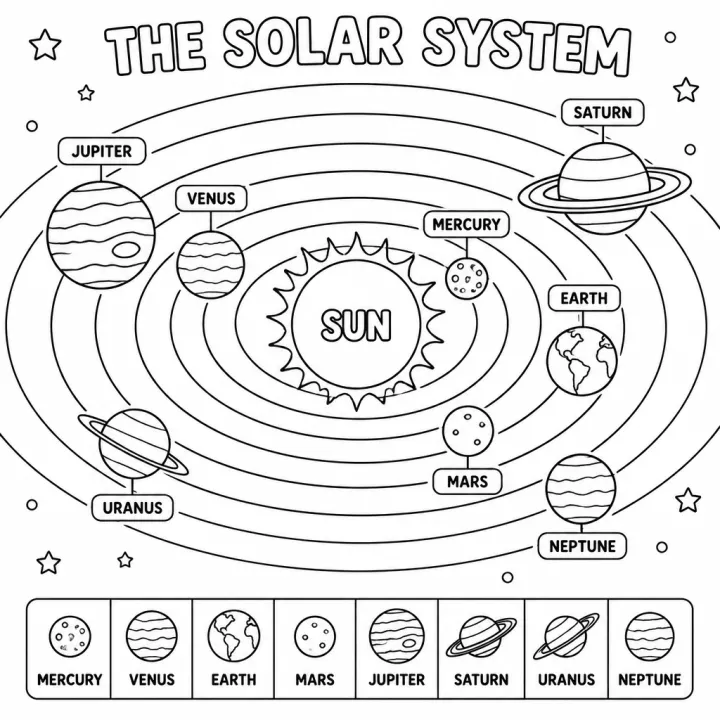
A first trip through our solar system, one stop per page: 1. The Sun is a star that gives us light and warmth. 2. Mercury is closest to the Sun and the smallest planet. 3. Venus is the hottest planet. 4. Earth is our home, with oceans and air. 5. The Moon goes around Earth. 6. Mars is the red planet. 7. Jupiter is the biggest planet. 8. Saturn has bright rings of ice and rock. 9. Uranus spins on its side. 10. Neptune is cold, blue and very windy.
Why it works: Parents and preschool teachers want a gentle first space book with one easy fact per planet, in the right order from the Sun. Its short length is great for home printing.
Settings for AI agents (InkChamps MCP)
{
  "tool": "create_educational_coloring_book",
  "arguments": {
    "ageGroup": "3-6",
    "numberOfPages": 10,
    "highQuality": false,
    "pageSize": "8.5x11",
    "description": "A first trip through our solar system, one stop per page: 1. The Sun is a star that gives us light and warmth. 2. Mercury is closest to the Sun and the smallest planet. 3. Venus is the hottest planet. 4. Earth is our home, with oceans and air. 5. The Moon goes around Earth. 6. Mars is the red planet. 7. Jupiter is the biggest planet. 8. Saturn has bright rings of ice and rock. 9. Uranus spins on its side. 10. Neptune is cold, blue and very windy."
  }
}
Planets and space neighbors for ages 6-9
Ages
6-9
Pages
16
Size
8.5 × 11 in
Quality
Standard
Our solar system for early readers: 1. The Sun, the star at the center. 2. Planets travel around the Sun in orbits. 3. Mercury. 4. Venus. 5. Earth. 6. The Moon has craters. 7. Moon phases. 8. Mars and its rovers. 9. The asteroid belt. 10. Jupiter and its Great Red Spot storm. 11. Saturn's rings. 12. Uranus. 13. Neptune. 14. Pluto, a dwarf planet. 15. Comets have tails that point away from the Sun. 16. Astronauts explore space. Give each planet one fact: size, color, or how hot or cold it is.
Why it works: Grade 1-3 teachers can use one page a day during a space unit, and the moon phases and comet pages add facts beyond the planet list. Its short length is great for home printing.
Settings for AI agents (InkChamps MCP)
{
  "tool": "create_educational_coloring_book",
  "arguments": {
    "ageGroup": "6-9",
    "numberOfPages": 16,
    "highQuality": false,
    "pageSize": "8.5x11",
    "description": "Our solar system for early readers: 1. The Sun, the star at the center. 2. Planets travel around the Sun in orbits. 3. Mercury. 4. Venus. 5. Earth. 6. The Moon has craters. 7. Moon phases. 8. Mars and its rovers. 9. The asteroid belt. 10. Jupiter and its Great Red Spot storm. 11. Saturn's rings. 12. Uranus. 13. Neptune. 14. Pluto, a dwarf planet. 15. Comets have tails that point away from the Sun. 16. Astronauts explore space. Give each planet one fact: size, color, or how hot or cold it is."
  }
}
How the solar system works for ages 9-13
Ages
9-13
Pages
16
Size
8.5 × 11 in
Quality
Standard
How the solar system works, for upper elementary: 1. Gravity holds the planets in orbit around the Sun. 2. Earth spins once a day. 3. Earth orbits the Sun once a year. 4. Seasons come from Earth's tilted axis. 5. Moon phases. 6. Solar eclipse. 7. Lunar eclipse. 8. Rocky inner planets. 9. Gas and ice giants. 10. The asteroid belt. 11. Jupiter's moons. 12. Saturn's rings are pieces of ice and rock. 13. The Kuiper Belt and dwarf planets. 14. Comets. 15. Telescopes. 16. Rovers and probes explore other worlds.
Why it works: Homeschoolers and middle-grade teachers need the 'why' behind seasons, phases and eclipses, and a labeled picture of each makes the idea stick. Its short length is great for home printing.
Settings for AI agents (InkChamps MCP)
{
  "tool": "create_educational_coloring_book",
  "arguments": {
    "ageGroup": "9-13",
    "numberOfPages": 16,
    "highQuality": false,
    "pageSize": "8.5x11",
    "description": "How the solar system works, for upper elementary: 1. Gravity holds the planets in orbit around the Sun. 2. Earth spins once a day. 3. Earth orbits the Sun once a year. 4. Seasons come from Earth's tilted axis. 5. Moon phases. 6. Solar eclipse. 7. Lunar eclipse. 8. Rocky inner planets. 9. Gas and ice giants. 10. The asteroid belt. 11. Jupiter's moons. 12. Saturn's rings are pieces of ice and rock. 13. The Kuiper Belt and dwarf planets. 14. Comets. 15. Telescopes. 16. Rovers and probes explore other worlds."
  }
}
Tips for making a solar system coloring book
Keep the planets in order from the Sun in the brief; kids learn the order by turning the pages.
Give each planet one memorable fact (Jupiter is the biggest, Venus is the hottest) rather than a paragraph.
Mention that Pluto is a dwarf planet; teachers check for that.
Make your own solar system coloring book
Start from one of these prompts or write your own. InkChamps turns it into a print-ready PDF.