Water Cycle and Weather Coloring Book Prompts for Kids
The water cycle and weather are early science staples, and kids understand evaporation better once they have colored the Sun warming a puddle. These prompts cover a simple rain story for preschoolers, a weather book for 6 to 9 year olds and an in-depth water cycle book with real vocabulary for older kids. Each page holds one idea and one short caption.
Where does rain come from
Ages
3-6
Pages
10
Size
8.5 × 11 in
Quality
Standard
A simple water cycle story for little kids: 1. The Sun warms the water in the sea, lakes and puddles. 2. Tiny bits of water rise into the air where we cannot see them. 3. High up, the air is cold and the water makes clouds. 4. The clouds get full and heavy. 5. Rain falls down. 6. When it is very cold, snow falls instead. 7. Rain makes puddles, streams and rivers. 8. Rivers flow back to the sea. 9. Plants and animals drink the water. 10. The Sun warms the water again and the cycle goes round.
Why it works: Preschool and kindergarten teachers want the water cycle as a simple circular story with no hard words, and ten steps fit a two-week weather unit. Its short length is great for home printing.
Settings for AI agents (InkChamps MCP)
{
  "tool": "create_educational_coloring_book",
  "arguments": {
    "ageGroup": "3-6",
    "numberOfPages": 10,
    "highQuality": false,
    "pageSize": "8.5x11",
    "description": "A simple water cycle story for little kids: 1. The Sun warms the water in the sea, lakes and puddles. 2. Tiny bits of water rise into the air where we cannot see them. 3. High up, the air is cold and the water makes clouds. 4. The clouds get full and heavy. 5. Rain falls down. 6. When it is very cold, snow falls instead. 7. Rain makes puddles, streams and rivers. 8. Rivers flow back to the sea. 9. Plants and animals drink the water. 10. The Sun warms the water again and the cycle goes round."
  }
}
Weather and seasons for ages 6-9
Ages
6-9
Pages
14
Size
8.5 × 11 in
Quality
Standard
Kinds of weather and how we measure them: 1. Sunny. 2. Cloudy. 3. Rainy. 4. Windy. 5. Snowy: snowflakes have six sides. 6. Foggy: a cloud near the ground. 7. Thunderstorms: we see lightning before we hear thunder. 8. Rainbows: sunlight shining through raindrops. 9. Hail: balls of ice from storm clouds. 10. Spring. 11. Summer. 12. Fall. 13. Winter. 14. Weather tools: a thermometer, a rain gauge and a wind vane. Show a child dressed right for each weather; for thunderstorms and hail, show the child safely indoors at the window.
Why it works: Grade 1-2 teachers cover weather types, seasons and tools in one unit, and this book matches that outline page for page. Its short length is great for home printing.
Settings for AI agents (InkChamps MCP)
{
  "tool": "create_educational_coloring_book",
  "arguments": {
    "ageGroup": "6-9",
    "numberOfPages": 14,
    "highQuality": false,
    "pageSize": "8.5x11",
    "description": "Kinds of weather and how we measure them: 1. Sunny. 2. Cloudy. 3. Rainy. 4. Windy. 5. Snowy: snowflakes have six sides. 6. Foggy: a cloud near the ground. 7. Thunderstorms: we see lightning before we hear thunder. 8. Rainbows: sunlight shining through raindrops. 9. Hail: balls of ice from storm clouds. 10. Spring. 11. Summer. 12. Fall. 13. Winter. 14. Weather tools: a thermometer, a rain gauge and a wind vane. Show a child dressed right for each weather; for thunderstorms and hail, show the child safely indoors at the window."
  }
}
The water cycle in depth for ages 9-13
Ages
9-13
Pages
12
Size
8.5 × 11 in
Quality
Standard
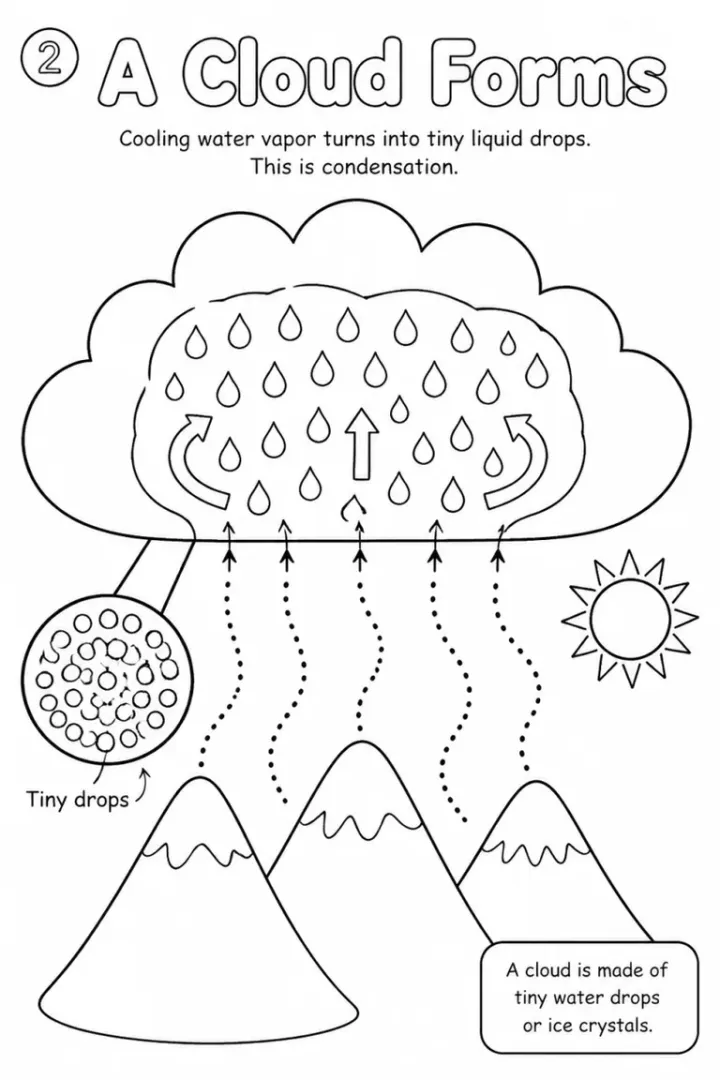
The water cycle with real science words: 1. Most of Earth's water is salty ocean; only about 3% is fresh. 2. Evaporation: the Sun turns water into vapor. 3. Transpiration: plants release water through their leaves. 4. Condensation: vapor cools into droplets and forms clouds. 5. Cloud types: cumulus, stratus, cirrus, cumulonimbus. 6. Precipitation: rain, snow, sleet, hail. 7. Runoff into streams. 8. Infiltration into soil. 9. Groundwater and aquifers. 10. Glaciers and ice caps store fresh water. 11. Water treatment. 12. Saving water.
Why it works: Upper elementary teachers need evaporation, transpiration and infiltration taught as separate steps, and homeschoolers get a ready-made unit. Its short length is great for home printing.
Settings for AI agents (InkChamps MCP)
{
  "tool": "create_educational_coloring_book",
  "arguments": {
    "ageGroup": "9-13",
    "numberOfPages": 12,
    "highQuality": false,
    "pageSize": "8.5x11",
    "description": "The water cycle with real science words: 1. Most of Earth's water is salty ocean; only about 3% is fresh. 2. Evaporation: the Sun turns water into vapor. 3. Transpiration: plants release water through their leaves. 4. Condensation: vapor cools into droplets and forms clouds. 5. Cloud types: cumulus, stratus, cirrus, cumulonimbus. 6. Precipitation: rain, snow, sleet, hail. 7. Runoff into streams. 8. Infiltration into soil. 9. Groundwater and aquifers. 10. Glaciers and ice caps store fresh water. 11. Water treatment. 12. Saving water."
  }
}
Tips for making a water cycle and weather coloring book
Write the cycle as a sequence of steps so the pages follow the water from the sea, up to the clouds and back.
Use the four key words, evaporation, condensation, precipitation and collection, from age 6 up.
For weather books, pair each kind of weather with what you wear or do in it; young kids remember the umbrella.
Make your own water cycle and weather coloring book
Start from one of these prompts or write your own. InkChamps turns it into a print-ready PDF.