
Are Flashcards Good for Toddlers? What Works, What Doesn't, and How to Make Your Own
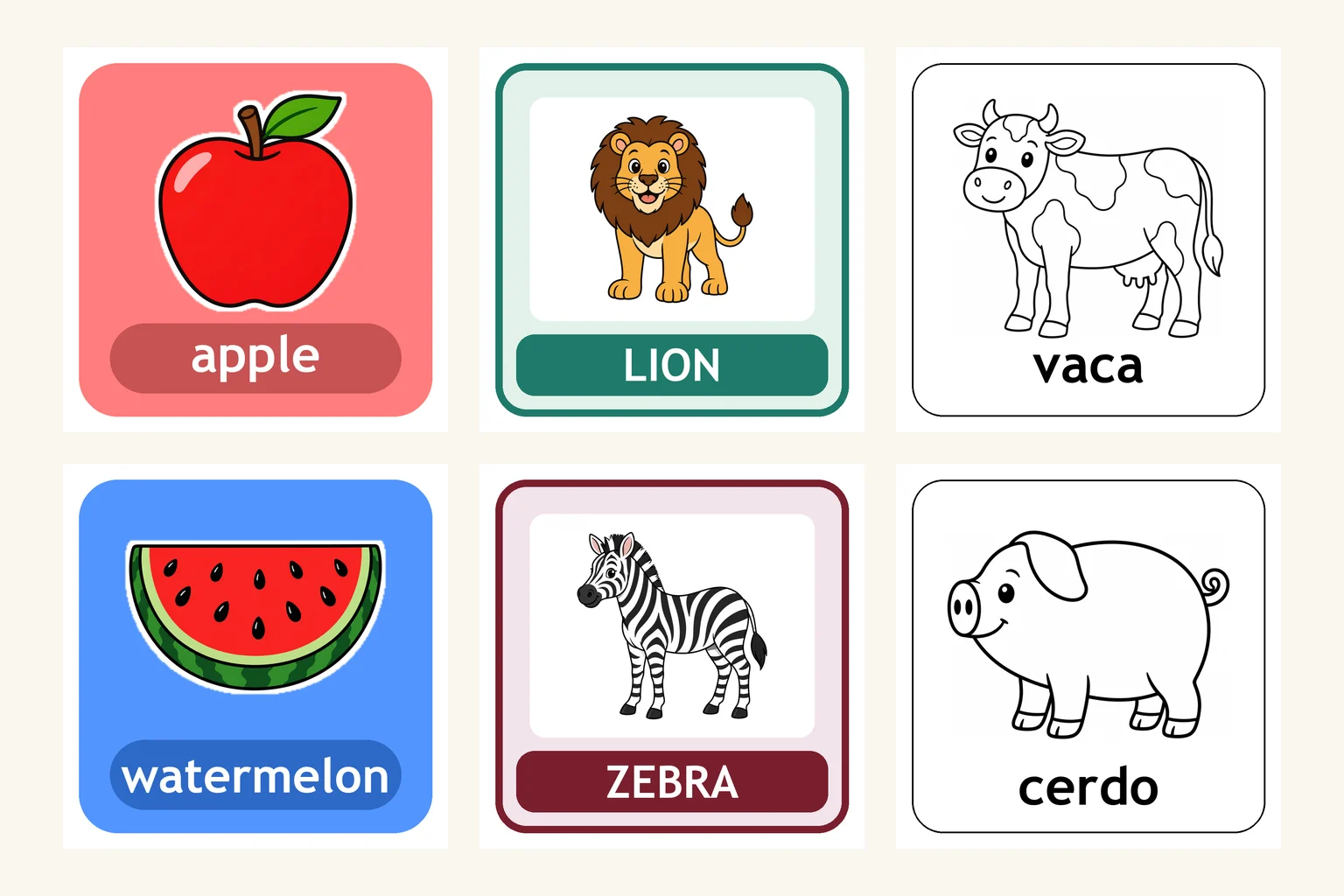
Flashcards have a mixed reputation. Some parents swear by them. Child-development experts have been warning against them for twenty years. Both are right, because they are talking about two different things.
Short answer: flashcards used as a drill ("What's this? What's this? What's this?") do little for a toddler. The same cards used as something to talk about, point at, hide, sort and play with are a good tool. For school-age children, quizzing themselves with cards is one of the best-tested ways to remember things.
This guide covers what the research says, what age to start, ten games to play, and how to make picture cards on exactly the topic your child cares about.
Do flashcards work for toddlers?
Not the way the boxes promise. The National Association for the Education of Young Children (NAEYC) puts it bluntly in its article Toddlers and Reading: Describe but Don't Drill: using flash cards is not an effective way to build toddlers' language and early reading skills, because they train memorizing. A child who has learned to say "apple" at the sight of a card has learned that card. That isn't the same as learning language.
What does build language at this age is conversation: hearing lots of words, in sentences, about things the child cares about, and being answered when they try to talk. The psychologists Kathy Hirsh-Pasek and Roberta Michnick Golinkoff made the same case in a whole book, Einstein Never Used Flash Cards (2003): young children learn more from play than from memorizing.
So the problem isn't the card. It's the drill. Here's the difference:
| A drill | A conversation |
|---|---|
| "What's this?" "Cow." "Good! What's this?" | "Look, a cow! She's eating grass. Do you remember the cows we saw at the farm?" |
| A pile of cards, one after another | Two or three cards, talked about for as long as the child is interested |
| A right or wrong answer | Any answer is a way into a chat |
| Stops when the cards run out | Stops when the child loses interest |
Used the second way, a picture card is like a page from a picture book that you can carry around, hide under a cushion or match to a real banana. That's a good tool.
What the research says about pictures and young children
Two findings are worth knowing before you buy or make a deck.
Toddlers can learn words from pictures, and the picture style matters. In a study by Patricia Ganea, Melissa Pickard and Judy DeLoache (2008), 15- and 18-month-olds learned a new word from a picture book and then used it for the real object. They did this more easily when the pictures were realistic than when they were cartoony. For the youngest children, pick clear, simple pictures of one thing on a plain background, and connect the card to the real thing whenever you can.
For older children, quizzing beats re-reading. Being asked to recall something, rather than just looking at it again, makes it stick. Most of this research was done with college students, so Jeffrey Karpicke and colleagues tested it with elementary school children (2016). Recall practice helped them too, whatever their reading level. A flashcard is a recall prompt: you see the picture and try to remember the word, or the other way round.
Spreading practice out helps. Haley Vlach and Catherine Sandhofer taught 5- to 7-year-olds a science topic either all at once or spread over several days (2012). The children with spread-out lessons were better at applying what they learned to new examples. With cards, a few minutes a day beats one long session on Saturday.
Together: for toddlers, use the cards to talk. For school-age children, quiz with them, a little at a time.
What age should you start using flashcards?
There's no official age, but here's a sensible guide:
- Around 1 to 2 years: picture cards as a talking tool, if your child enjoys picture books. A few cards of everyday things (dog, cup, ball, banana), never a quiz.
- 2 to 3 years: pointing and finding games ("Where's the duck?"), sorting, and matching cards to real objects. Add a few cards at a time.
- 3 to 5 years: more topics (vehicles, feelings, jobs, a second language), memory games, and cards with the word printed clearly under the picture so letters start to look familiar.
- 5 and up: real self-quizzing for vocabulary, a second language or school topics, with the cards sorted by how well your child knows them (see the box method below).
If you make your own cards in InkChamps (see below), the Ages 1–3 setting covers the first two stages.
The best sign of readiness is simple: your child is enjoying it. If they're wriggling away, put the cards down. A toddler who has had enough isn't learning, and pushing on only teaches them that the cards are a chore.
The downsides of flashcards (and how to avoid them)
- Drilling and pressure. The biggest problem, covered above. Keep it short, keep it a game, and stop on a good note.
- Memorizing without meaning. A child can learn to say "giraffe" at a picture without knowing anything about giraffes. Talk about each card: what it does, where you've seen one, what sound it makes.
- Testing instead of teaching. "What's this?" is a test. "That's a fire engine, it's going to a fire!" is teaching. With toddlers, say much more than you ask.
- Too many cards at once. Start with five or six. A boxed set of 100 cards is mostly a box.
- Cards that don't match the child's life. A toddler in a city flat doesn't need "yak". Cards of things they actually see (their food, their toys, the animals at the nearby park) give you much more to talk about.
10 flashcard games for toddlers and kids
None of these needs more than a deck of picture cards. The first five suit toddlers. The rest work best from about age 3 or 4.
- Show and tell. Pick a card and talk about it together: "A cow! Cows say moo. Cows give us milk. What did you have on your cereal this morning?" No questions with a right answer.
- Where's the…? Lay out two or three cards and ask your child to point to one. Pointing is easier than saying the word, so very young children can join in.
- Match the real thing. Put a card next to the real object: the banana card on the fruit bowl, the car card next to a toy car. This is how a picture starts to mean the real thing.
- Hide and find. Hide a few cards around the room, partly showing. When your child finds one, name it together and celebrate.
- Feed the monster. Draw a mouth on a shoe box. "The monster is hungry for… the apple!" Your child finds the card and posts it in. Toddlers will play this for ages.
- Sort into groups. Animals that fly and animals that swim. Things that are red. Food and not food. Sorting teaches categories, not just names.
- What's missing? Lay out four cards, let your child look, then hide one while they close their eyes. Which one has gone? Start with three cards and work up.
- Pairs. Print two copies of the deck, lay them face down, and take turns turning over two at a time to find matches.
- Story chain. Pick three cards at random and make up a story that uses all three: a pig, a rocket and an umbrella. Older children can take turns adding a card each.
- Act it out. One person picks a card and acts it out (a frog, a firefighter, "sleepy") while the others guess.
Flashcards for speech practice
Picture cards are a standard tool in speech therapy, because they give a child a clear, repeatable thing to say. If your child sees a speech-language therapist, ask which words or sounds to practice at home and make cards of exactly those words: words starting with "b", say, or your child's own target list.
The same rules apply: short sessions, lots of praise for trying, and plenty of talk around each card. A therapist's advice about your own child always comes first.
Flashcards for a second language
Cards are especially useful for families raising a child in two languages, or a child learning one at school. Pick everyday things your child already knows in one language and make a deck with the words in the other. Use the cards in the same games as above, in that language.
Store-bought sets usually cover English and perhaps Spanish or French. If your family speaks Nepali, Korean or Arabic at home, homemade cards are often the only way to get them.
For school-age children: the box method
Once your child can read the cards themselves, the Leitner box is a simple way to put spread-out recall into practice:
- Take three boxes or envelopes: Every day, Every few days and Once a week.
- All cards start in Every day.
- When your child gets a card right, it moves up one box. When they get it wrong, it goes back to Every day.
- Practice each box on its schedule.
Cards your child knows come up less often, and the tricky ones keep coming back. Ten minutes a day is plenty. Two-sided cards work best here: the picture on the front, the word or answer on the back.
Store-bought vs. homemade flashcards
Boxed sets are quick, but they decide the topic, the language and the pictures for you. Homemade cards let you pick the exact things your child sees and talks about, which is the whole point for a toddler. You can make them three ways:
- Draw them. Index cards and a marker. Children love seeing a parent draw, even badly. It takes time, and older children often want "real" pictures.
- Cut them out. Pictures from old magazines or catalogs glued onto card. Good for real-life photos, harder for a specific topic.
- Print them. Design them in a template tool, or describe them and let a flashcard maker draw them.
How to make printable flashcards with InkChamps
The InkChamps flashcard maker draws a picture for every card and lays the deck out on sheets to print and cut out at home.
- Describe the cards in your own words. For example: "animals and food for a 2 year old", "farm animals, include a tractor", or "things in our kitchen". Name anything that must be in the deck, like your child's favorite animal or the family dog.
- Choose who it's for. Under Who it is for, pick Ages 1–3 for a toddler's first words, or an older group up to 13–18. The age decides which things go in the deck and how simply each word is written.
- Pick a language. Write the description in that language, or just ask, for example "farm animals in Spanish". Words print in their own script, including Hindi, Nepali, Arabic, Chinese, Japanese and Korean.
- Choose a template. Picture + word gives square cards of about 3.2 inches (8 cm), six to a US Letter sheet, with the word under the picture. This is the one for toddlers. Fold and glue gives two-sided cards, three to a sheet: the picture on one half and the word with a short fact on the other. Fold, glue, and you have a card with the answer on the back, with no double-sided printing needed. Those suit the box method and older children.
- Choose color or black and white. Color is best for toddlers, who learn a banana is yellow from the card. Black and white prints every picture as outlines, so an older child can color each card in before you cut it out. That's one more chance to talk about every card.
- Pick how many cards: 12, 24, 36 or 48. A 12-card deck is a good first set for a toddler.
- Download, print and cut. Print on card stock if you can, and cut along the dashed lines.
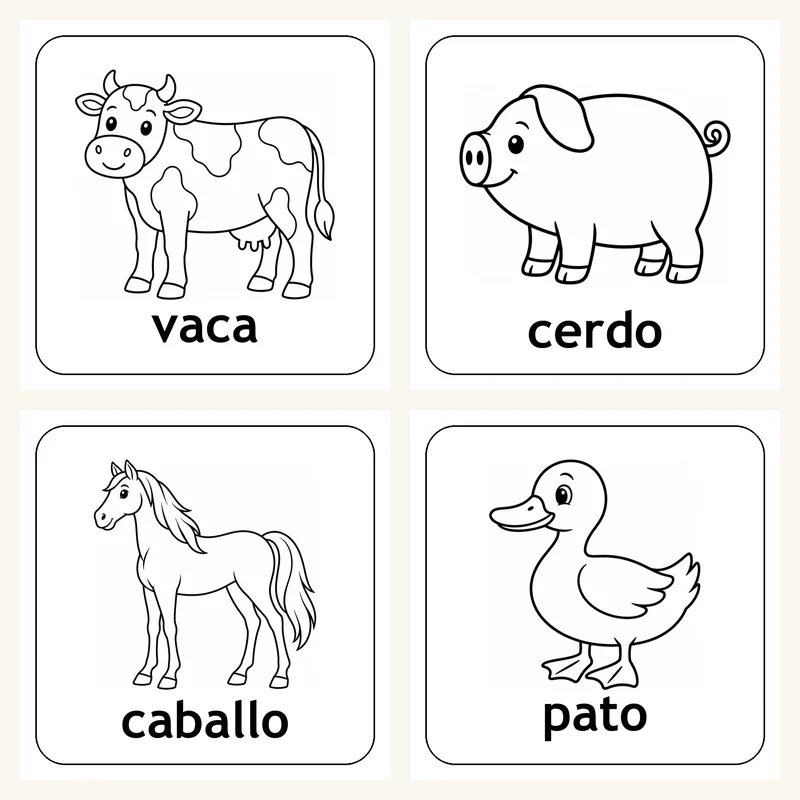
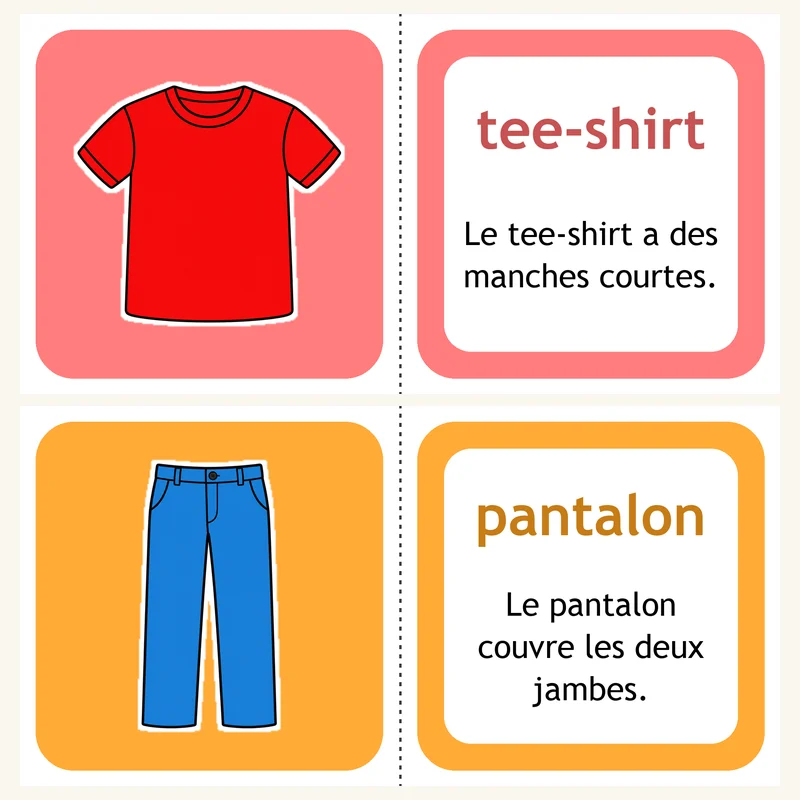
A few things it does that are hard to do by hand. Every word is typeset rather than drawn, so nothing is misspelled. Every card in a deck is drawn in the same style. And if you have a card design you like, you can upload it as a template, and every card in the deck will follow its border, corners and layout.
One honest note, based on the picture research above: InkChamps draws clear, simple illustrations of one thing on a plain card, not photos. For a child under 2, pair the cards with the real thing as often as you can, and talk about both.
Each card uses 1 credit, so a 12-card deck uses 12 credits. See pricing for credit packs.
Sources
- NAEYC, Toddlers and Reading: Describe but Don't Drill
- Ganea, P. A., Pickard, M. B., & DeLoache, J. S. (2008). Transfer between picture books and the real world by very young children. Journal of Cognition and Development, 9(1), 46–66.
- Karpicke, J. D., Blunt, J. R., & Smith, M. A. (2016). Retrieval-based learning: Positive effects of retrieval practice in elementary school children. Frontiers in Psychology, 7, 350.
- Vlach, H. A., & Sandhofer, C. M. (2012). Distributing learning over time: The spacing effect in children's acquisition and generalization of science concepts. Child Development, 83(4), 1137–1144.
- Hirsh-Pasek, K., & Golinkoff, R. M., with Eyer, D. (2003). Einstein Never Used Flash Cards: How Our Children Really Learn—and Why They Need to Play More and Memorize Less. Rodale.
Frequently asked questions
- Are flashcards good for toddlers?
- Used as a drill, not really: NAEYC says flash cards are not an effective way to build toddlers' language skills, because they train memorizing. Used as something to talk about, point at, hide and match to real objects, picture cards are a good tool. The difference is conversation, not the cards.
- What age should I start using flashcards?
- There's no official age. Picture cards can be a talking tool from around 1 to 2 years if your child enjoys picture books. Pointing and matching games suit 2 to 3, memory games 3 to 5, and real self-quizzing works from about 5. The best sign of readiness is that your child is enjoying it. The InkChamps flashcard maker has an Ages 1–3 setting for first-word cards.
- What are the downsides of using flashcards?
- Drilling and pressure, memorizing words without meaning, testing instead of teaching, too many cards at once, and cards of things the child never sees. Keep sessions short and playful, talk about every card, and start with five or six cards from your child's own life.
- Does Montessori use flashcards?
- Montessori classrooms use picture cards called three-part or nomenclature cards: a picture, a label, and a card with both. They are taught with the three-period lesson (naming, recognizing, then recalling) rather than as a quick-fire drill.
- Can flashcards help with speech delay?
- Picture cards are a standard tool in speech therapy, because they give a child a clear, repeatable thing to say. If your child sees a speech-language therapist, ask which words or sounds to practice at home and make cards of exactly those. The therapist's advice comes first.
- How many flashcards should a toddler use at once?
- Start with five or six cards of everyday things and add a few at a time. Two or three cards talked about for as long as the child is interested do more than a whole deck flipped through quickly.
- How do I make my own flashcards for kids?
- Draw them on index cards, glue magazine pictures onto card, or print them. In the InkChamps flashcard maker, describe the cards in your own words, pick Ages 1–3 for a toddler (or an older group), choose a language, a template (picture + word, or fold and glue), color or black and white and 12 to 48 cards, then print the PDF on card stock and cut along the dashed lines. Each card uses 1 credit.
Make picture flashcards of your child's world
Describe the cards in your own words, in any language, and print them on US Letter sheets to cut out today.
Open the flashcard maker