
How Coloring Books Can Motivate Children Toward Their Dreams
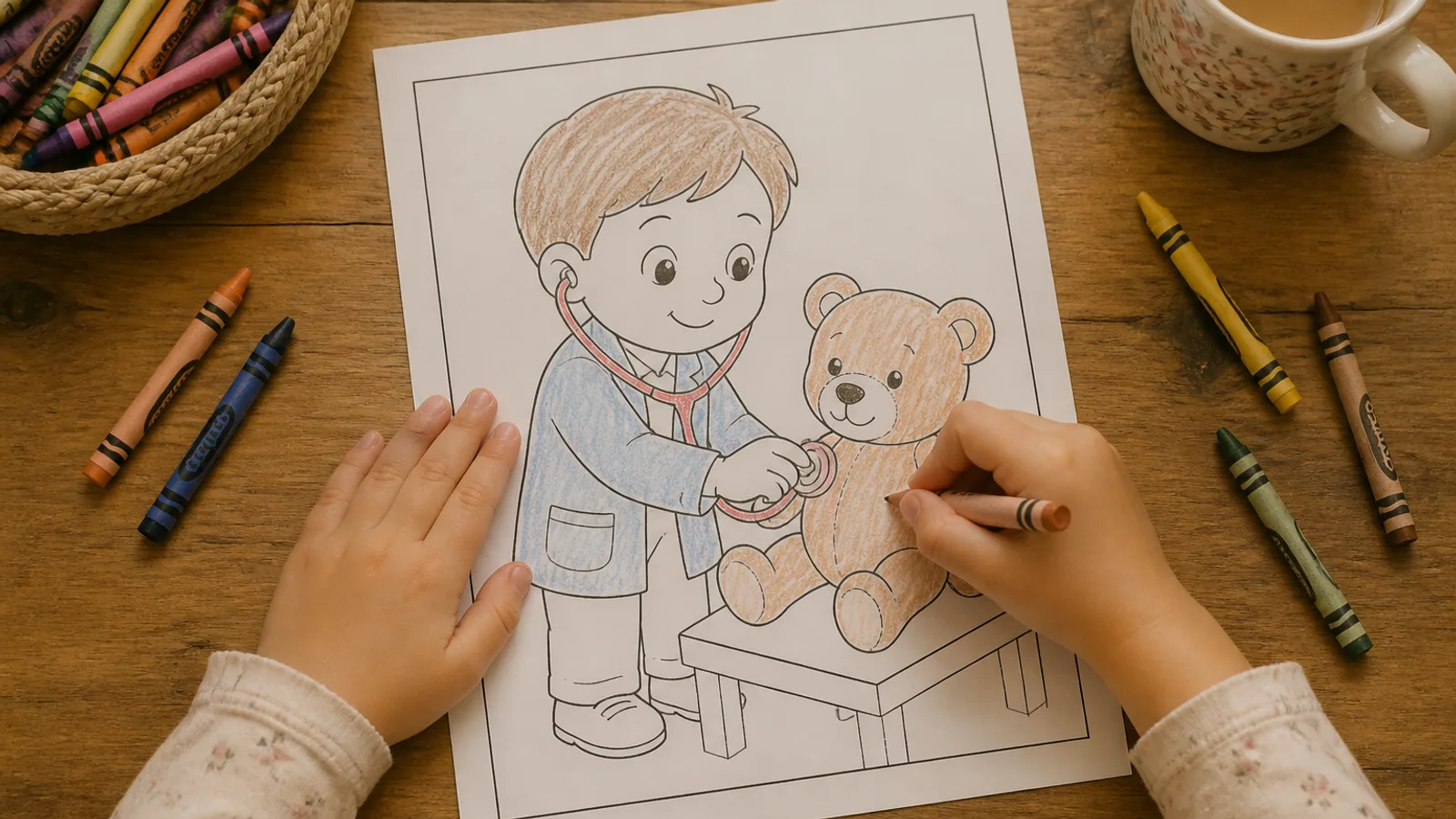
Ask a six-year-old what she wants to be, and you might hear "a doctor" with complete certainty. Ask again next month and the answer could be a baker, a pilot, or the person who drives the ice cream van.
That doesn't mean the first answer wasn't real. Children's dreams are sincere, but they are light. They show up after a visit to the clinic or a favorite cartoon, and unless something keeps feeding them, they drift away as quietly as they arrived.
This post is about one simple way to feed them: a coloring book built around the dream itself.
How we usually try to motivate children
Most of us reach for the same tools. We praise. We offer rewards for good marks. We say things like "If you study hard, you can become a doctor one day." Some families arrange a visit to a hospital or introduce the child to someone who does the job.
All of this helps, and none of it is wrong. But most of it comes from the outside, and most of it talks about a future that is very far away. To a six-year-old, "one day" might as well be never. A pep talk lasts as long as the conversation does.
What a young dream needs is something closer at hand: a way to spend time with the idea, in the present, without anyone telling them to.
Why a childhood dream fades
A dream fades in a child for the same reason a hobby fades in an adult: nothing in the day connects to it. There is no moment where they get to be the doctor, or think about what a doctor does, or notice something new about it.
The interest isn't lost because the child wasn't serious. It's lost because it had nothing to hold on to.
What happens while a child colors
Watch a child coloring a page they care about. They go quiet. They lean in. For fifteen or twenty minutes, that picture is the whole world.
They decide what color the doctor's coat should be. They give the teddy bear patient a blue bandage. They notice the stethoscope and ask what it's for. None of this feels like learning to them. It feels like play, and that is exactly why it works.
When the page is about the thing a child already dreams of, that time becomes time spent inside the dream. Do it often enough and the dream starts to feel familiar. Things that feel familiar feel possible.
An example: the child who wants to be a doctor
Picture a coloring book made for a child who says she wants to be a doctor. Not a random set of doctor coloring pages, but a book where every page is about the job she imagines. The pages might show:
- a young doctor listening to a teddy bear's heartbeat
- washing hands carefully before seeing a patient
- holding an X-ray up to the light
- sitting with a nervous child and explaining that the injection will be quick
- walking into the hospital in the morning, bag in hand
Each of these leaves a small impression. Being a doctor is not only about the white coat. It's about caring for people, being patient, being careful, and knowing how the body works. The child isn't reading this anywhere. She is picking it up while she colors.
The questions come on their own. Why does the doctor listen to your chest? What's an X-ray? Was that doctor scared on her first day? Those questions are the dream growing roots.
Fun first, knowledge second
It's tempting to turn this into a lesson. Don't, at least not at the start.
If the coloring book feels like homework, the child will treat it like homework. If it feels like a favorite activity, they'll come back to it on their own. Let it be a hobby first. The knowledge will follow because the interest is already there.
The best motivation for a child is the kind they don't notice is happening.
Three levels of coloring book for one dream
This is where it gets useful to think in stages. A single coloring book is a nice gift. Three different kinds, introduced over time, can carry a dream much further. At InkChamps we make three types, and they fit this progression naturally.
Level 1: A coloring book to meet the dream
Start with a regular coloring book built around the theme: single pictures, no reading required. A doctor's clinic, an ambulance, a teddy bear with a sling, a stethoscope on a desk.
The goal here is only familiarity and enjoyment. This level works for the youngest children, even those who can't read yet. Leave it on the table and let them pick it up when they want.
Level 2: A story coloring book to live the dream
Once the theme has stuck, move to a story coloring book. Each page pairs a picture with a line of story, so the pages follow a character from beginning to end: a girl named Maya on her first day helping at the town clinic, the patient who was frightened, the moment she helped him feel better.
You describe the story you want, and the main character can be your child (more on that below). Now the child isn't only coloring a doctor. She is following someone like her through a day in the job, and imagining herself in that role.
Level 3: An educational coloring book to understand the dream
When the questions start getting specific ("How does the heart work?"), that's the moment for an educational coloring book. Each page shows one step of a real process with a big picture and a short caption: how the heart pumps blood, how a broken bone heals, what germs are and why we wash our hands.
This is the level that turns a feeling into knowledge. The child starts to understand what the profession actually involves, and that understanding is what makes a dream sturdy.
| Level | Book type | What the child does | What it builds |
|---|---|---|---|
| 1 | Coloring book | Colors scenes from the dream | Familiarity and enjoyment |
| 2 | Story coloring book | Follows a character through the job | Identity: "someone like me does this" |
| 3 | Educational coloring book | Colors how things really work | Real knowledge of the field |
Make your child the main character
There is one more step that makes all of this land harder: put your child in the pages.
In InkChamps, the coloring book and story coloring book creators both have an optional step called "Who is in your book?". Upload a photo of your child, give the character their name, and the pages are drawn with your child in them. Here is how a personalized coloring book from your child's photo works. Your child is no longer coloring a doctor in a white coat. They are coloring themselves in that coat, holding the stethoscope, walking into the hospital.
Children notice this immediately. A page with their own face on it tends to get colored more carefully, kept longer, and shown to everyone who walks into the house. It also makes the dream personal in a way a shop-bought book can't: "someone like me does this" becomes "I do this."
A few ways to use it:
- In a plain coloring book, make your child the doctor on every page: at the clinic, in the ambulance, checking the teddy bear.
- In a story coloring book, add the people around them too. Upload a photo of a grandparent and make them the patient your child helps.
- For a sibling with a different dream, make a second book with the same photo idea. The vet and the astronaut each get their own.
Educational coloring pages work differently: they explain a topic step by step, so they don't take a character photo. By the time a child reaches that level, they already know they're the one learning it.
Not sure what your child's dream is yet?
Plenty of children don't have one clear answer, and that's fine. Coloring can also help you find out what they care about.
Make a "when I grow up" coloring book with a different job on each page: a doctor, a vet, a pilot, a chef, a builder, a scientist, a teacher, a farmer. Then watch. Which pages get colored first? Which ones get extra detail? Which ones do they talk about while they color, and which do they skip?
Children often show what they're drawn to long before they can say it. A handful of career coloring pages is an easy, low-pressure way to see it. When one theme keeps coming back, that's your Level 1.
How to plan the three together
There's no strict schedule, but a rough pattern works well:
- Begin with Level 1 and let the child enjoy it without any expectations.
- Bring in Level 2 when they start talking about the theme on their own, or ask for "more doctor pages."
- Bring in Level 3 when the "why" and "how" questions show up.
Follow the child's pace, not the plan. Some children will want the educational pages within a week. Others will happily stay at Level 1 for months, and that's fine.
And if the dream changes, change with it. The same three steps work just as well for a future vet, astronaut, chef, engineer, or firefighter. The point was never to lock in one career. It was to show the child that wanting something is the start of learning about it. (We wrote more about that side of it in how to motivate a child to follow their dreams.)
A few things that make it work better
- Color with them. A child who sees you interested takes the theme more seriously.
- Ask, don't explain. "What do you think the doctor is listening for?" goes further than a lecture.
- Keep finished pages where they can see them. The fridge door is a perfectly good gallery, and a wall of doctor drawings is a daily reminder of the dream.
- Don't treat a change of mind as failure. Look for what stays the same. A child who moves from doctor to vet still wants to care for someone.
Final thoughts
A coloring book won't decide what a child becomes. What it can do is keep a dream around long enough for the child to find out whether it's really theirs, and give them a little real knowledge along the way.
Start with pictures they love. Add a story they can see themselves in. Then, when they're ready, show them how it all works. That's a lot of motivation to get from a box of crayons.
Frequently asked questions
- Can a coloring book really motivate a child?
- Not on its own, and not overnight. What it does is give a child regular, enjoyable time with an idea they already like. That repeated time keeps the interest alive and makes it feel familiar, which is often what a young dream needs most.
- What are the benefits of coloring books for kids?
- Coloring builds hand control and focus, and it calms children down. When the pages are about something a child already loves, such as a job they dream of, it also keeps that interest alive and opens up conversations about it.
- What age is right for a career-themed coloring book?
- A simple coloring book with single scenes works from around age 3. Story coloring books suit children who enjoy being read to or are starting to read, and educational coloring books fit best once a child begins asking how things work.
- Can I make a coloring book with my child's photo?
- Yes. In InkChamps, the coloring book and story coloring book creators let you upload a photo of your child and give the character their name, so your child appears on the pages. Educational coloring pages don't use a character photo.
- What if my child changes their mind about what they want to be?
- That is normal. Make the next book about the new dream. The same three steps, from pictures to a story to how it really works, apply to any profession.
- Should the coloring book teach facts from the start?
- No. Start with fun. If it feels like homework the child will treat it like homework. Bring in the educational pages once the child is asking questions on their own.
Make a coloring book around your child's dream
Upload your child's photo, describe their dream, and print a coloring book they star in.
Create a coloring book