
Most KDP books that get zero sales aren't bad books. They're the same book everyone else already made, published into a crowded search, with no plan to bring buyers to it. Selling on KDP isn't magic. It's a process, and every step needs effort.
Here's the mistake I see the most. You search Amazon for "coloring book for kids", you see lots of books with lots of reviews, and you think: huge demand, I'll make one too. You make the book, set a price, publish it and wait.
But look at what that search really shows:
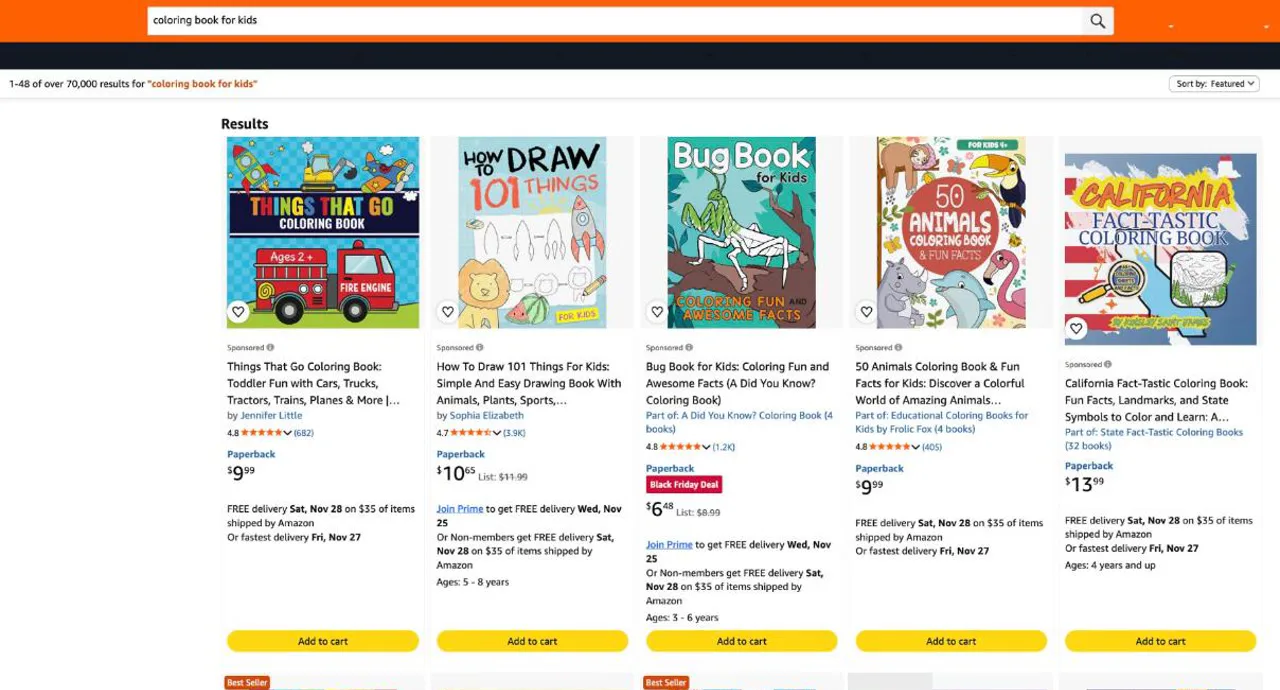
Over 70,000 results (amazon.com, 24 November 2026). A new book with no reviews lands somewhere deep in that list, and nobody scrolls that far. That's where the zero sales come from.
Nowadays making the book is the easy part. You can make one in an afternoon with the tools we have. So most of your effort should go into the steps around it. Here they are, in order.
Step 1: Pick your niche, then a smaller niche inside it
First decide what kind of book you're making: a coloring book, an activity book, an educational coloring book, a story book, a journal.
Then go one level down. "Coloring book" isn't a niche, it's a whole shelf. Inside it there are many smaller niches, for example:
- mandala coloring books for adults
- animal coloring books for kids aged 4 to 8
- dinosaur coloring books for toddlers
- cozy coloring books for adults
Pick one. The smaller and clearer your niche, the easier it is for the right buyer to find you.
Step 2: Check demand and competition, both
This is where most people go wrong. Demand alone doesn't mean your book will sell. A niche can be in demand and still be overcrowded, because everyone else found the same demand.
What you're looking for is one of these two:
- good demand, with room for a new book, or
- average demand, with a clear gap you can get into
To check a niche on Amazon, search it and look at the top books:
- Best Sellers Rank (BSR): a lower number means it sells more. If the top books have good ranks, people are buying.
- Reviews: if every top book has thousands of reviews, a new book will struggle. If some books with under 100 reviews still sell well, there's room for you.
- Publish dates: newer books that already sell tell you the niche is still open.
Doing this by hand for every idea takes hours. I use Niche Scout, a free Chrome extension we made at InkChamps. It reads the top books on any Amazon search and gives you one answer, Good, Okay, Crowded or Low demand, with the ranks, reviews and prices behind it. Under each book it also shows about how many copies it sells a day.
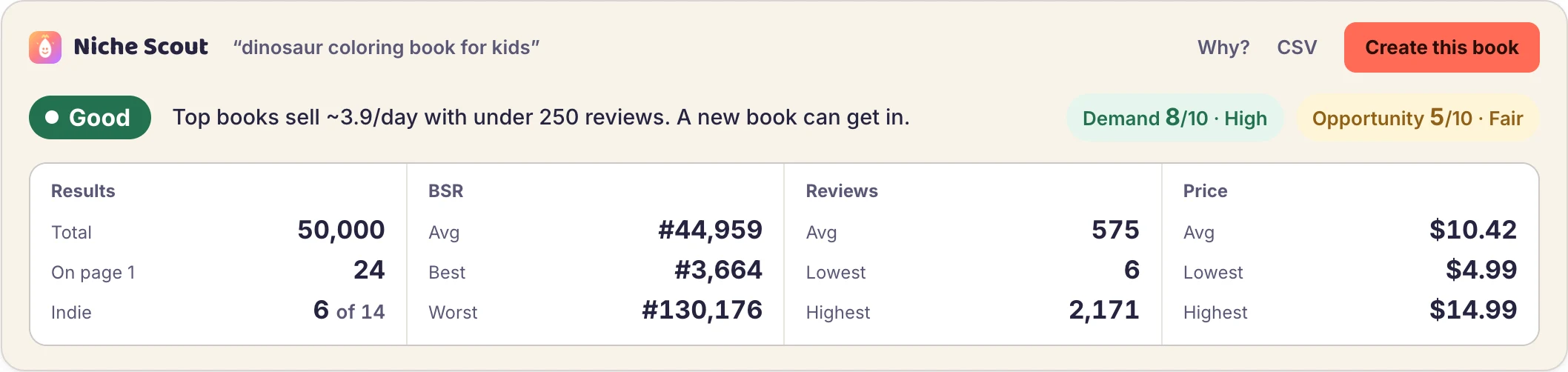
If a phrase comes back Crowded, don't give up on the idea. Make it narrower: add an age, a theme or who it's for.
Step 3: Follow the trends
Coloring books have trends too. Some are seasonal: Halloween, Christmas, Valentine's Day, Easter. They sell for a few weeks each year, so you have to publish well before the season starts. Others are general trends that last longer.
Right now, for example, cozy coloring books (simple, thick-lined doodle pages of cozy rooms, cafés and cute animals) are doing really well. I wrote more about it in Cozy Coloring Pages: A Niche That Sells.
A trend gives your book a push, but it still has to pass step 2. Popular trends fill up fast.
Step 4: Do keyword research
Amazon is a search engine. People don't browse KDP books, they search for them. If your book doesn't show up for what buyers type, they will never see it, no matter how good it is. And new books are published to KDP every day, so the competition for each search keeps growing.
Your keywords go in three places:
- your title
- your subtitle
- KDP's 7 keyword boxes (up to 50 characters each), which buyers never see but Amazon reads
Good keywords are phrases real buyers type, usually longer ones, like "dinosaur coloring book for kids ages 4-8" instead of just "dinosaur coloring book". Longer phrases have fewer books competing for them.
The easiest place to find them is Amazon's own search box: start typing and look at what it suggests. Those suggestions come from real searches. Niche Scout lists them for you with demand and competition for each, so you can see which ones give a new book a real chance:
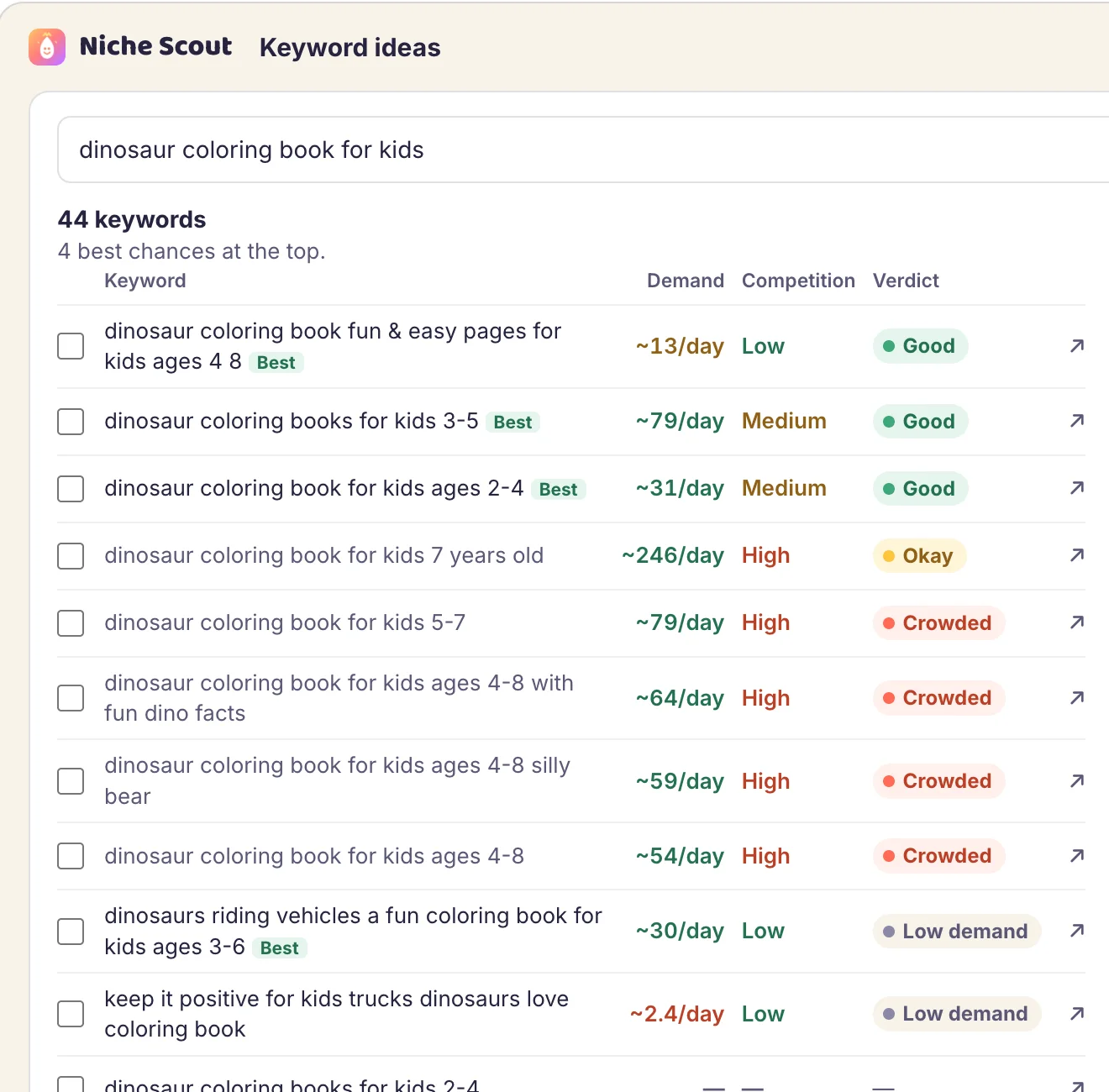
Tick the ones you like and it fills your 7 keyword boxes for you, within KDP's rules. This step is worth the time. A good keyword is the difference between a book that gets found and one that doesn't.
Step 5: Make the book
Now you can open a tool and make the book. You can use any tool you like. I use InkChamps (yes, it's ours), because KDP is strict about coloring books: the trim size, the bleed, the margins, the spine width on the cover. Get one wrong and KDP sends the book back. InkChamps handles all of that, and it makes a cover that fits your page count, so you get the full package ready to upload.
If you want to understand the print rules yourself, read KDP Coloring Book Size, Margins and Bleed.
Step 6: Get the sales
Once the book is live, sales come from two places.
1. Organic sales on Amazon
If your research in steps 1 to 4 was done well, Amazon itself will show your book to people searching for it, and you'll start getting sales without paying for them. This is why the research matters so much.
But you can't depend only on this, especially for your first book.
2. Marketing
No matter how good your book is, most of your traffic will come from marketing.
Amazon Ads. From your KDP Bookshelf you can run ads for your book on Amazon. The usual place to start is Sponsored Products, the ads that show up in Amazon's search results. In short, here's how they work:
- You pay only when someone clicks your ad. You set a daily budget and how much you're willing to pay per click.
- Automatic targeting: Amazon picks the searches for you, based on your title and description. Easy to start with.
- Manual targeting: you pick the keywords yourself, with a match type: broad (any search that includes your words), phrase (your words together, in that order) or exact (only that search).
Ads work on keywords too, so the research from step 4 helps here as well. Start with a small budget, see which keywords get clicks and sales, and spend more on those.
Social media. Instagram Reels, TikTok, YouTube Shorts and Pinterest can all send buyers to your book. Pinterest works especially well for coloring books, because people go there to search for ideas, the same way they search Amazon. And again, keywords matter on every one of these platforms.
Be ready to fail first
I won't give you big hopes. Your first book will probably fail. Maybe your second and third too. That's normal.
With every book you learn something: how to read a niche, which keywords work, how to make a short video, how ads behave, maybe you meet an influencer who can share your book. Then one day, maybe your fourth book, it starts selling, because now you have the experience.
Just putting a book on Amazon and waiting doesn't work. You'll get zero sales, no matter how many books you publish. But people are still buying coloring books, and a lot of them. Trust me, the demand is there, and from what I see the market is still growing. What has changed is how books get sold. Follow the process, use every channel you can, and keep going.
Happy creating, and best of luck!
Free tools for the research
- Niche Scout: free Chrome extension for niche research, keyword ideas, sales estimates from BSR and your 7 KDP keyword boxes. No account needed. The optional AI extras (Pro) use InkChamps credits. See what it does.
- KDP Interior Checker: check your interior PDF before you upload it.
- 10 Best Coloring Book Niches for Amazon KDP: niches we scored by demand and competition.
Frequently asked questions
- Why is my book not selling on Amazon KDP?
- Usually because it went into a crowded search with no plan to get found. A search like "coloring book for kids" already shows over 70,000 results, so a new book with no reviews lands where nobody scrolls. Pick a smaller niche with room, use keywords buyers really type, and market the book.
- How do I get my first sale on KDP?
- Publish into a niche where books with under 100 reviews still sell, put real buyer phrases in your title, subtitle and 7 keyword boxes, then bring people to the book with a small Amazon ad and short videos or Pinterest pins.
- Is there a free KDP keyword research tool?
- Yes. Niche Scout is a free Chrome extension that lists the phrases Amazon suggests for your idea, with demand and competition for each, and can fill your 7 KDP keyword boxes. It needs no account; only the optional AI extras use InkChamps credits.
- Do Amazon Ads work for KDP books?
- They can, if your keywords are right. Sponsored Products ads show in Amazon's search results and you pay only per click. Start with automatic targeting or a few manual keywords on a small daily budget, then spend more on the keywords that bring sales.
- How many books do I need to publish before KDP sells?
- There's no fixed number. Many people's first few books fail. Each one teaches you more about research, keywords and marketing, and that experience is what makes a later book sell.
Done the research? Make the book
Describe your idea and InkChamps draws every page, sets the trim size, bleed and margins for KDP, and makes a cover that fits your page count.
Create your book